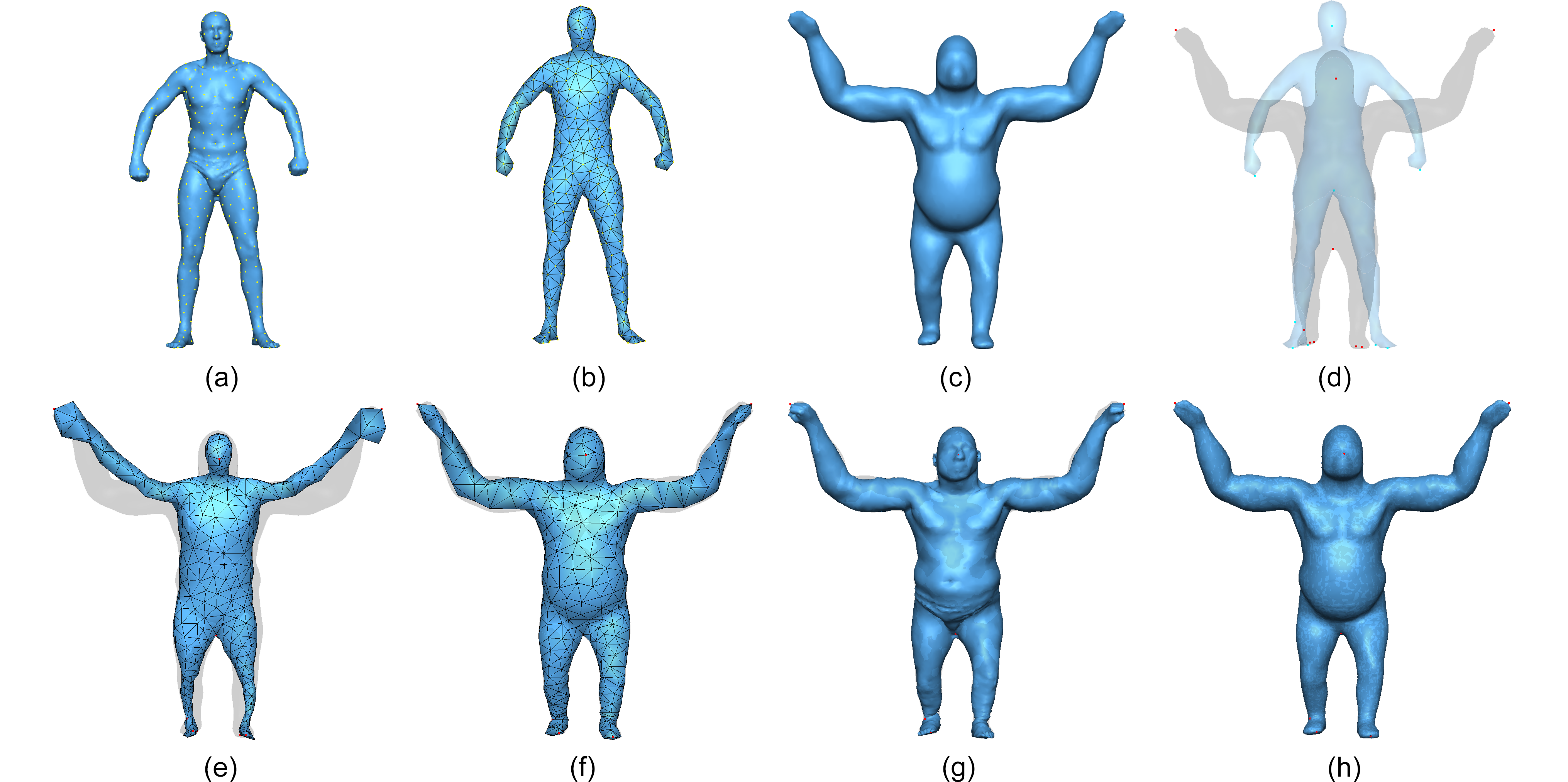
Surface registration algorithm overview: (a) Sampled points (marked as yellow dots) via farthest point sampling technique; (b) Remeshing from the sampled points as embedded coarse mesh; (c) Input of target surface; (d) The feature points specified by users (red dots for target and cyan dots for template); (e) Coarse fitting; (f) Mid-scale fittping; (g) Reconstructed through embedded deformation; (h) Fine fitting.
Abstract
Non-isometric surface registration, aiming to align two surfaces with different sizes and details, has been widely used in computer animation industry. Various existing surface registration approaches have been proposed for accurate template fitting, nevertheless, two challenges remain. One is how to avoid the mesh distortion and fold-over of surfaces during transformation. The other is how to reduce the amount of landmarks that have to be specified manually. To tackle these challenges simultaneously, we propose a consistent as-similar-as-possible (CASAP) surface registration approach. With a novel defined energy, it not only achieves theconsistent discretization for the surfaces to produce accurate result, but also requires a small number of landmarks with little user effort only. Besides, CASAP is constrained as-similar-as-possible so that angles of triangle meshes are preserved and local scales are allowed to change. Extensive experimental results have demonstrated the effectiveness of CASAP in comparison to the state-of-the-art approaches.
Publication
Tao Jiang, Kun Qian, Shuang Liu, Jing Wang, Xiaosong Yang, Jianjun Zhang. Consistent as-similar-as-possible non-isometric surface registration. The Visual Computer, 2017.