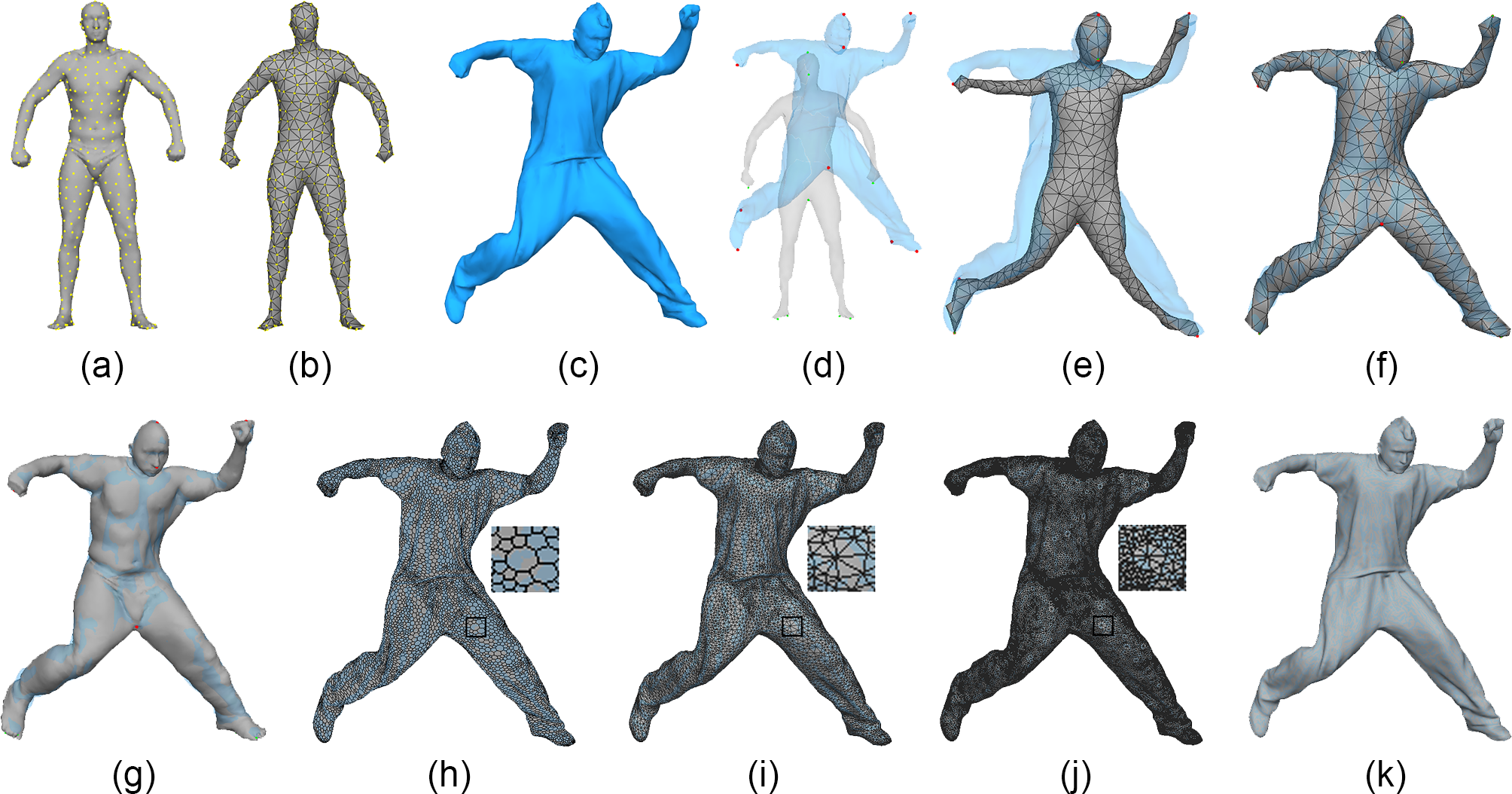
Huber-L1 algorithm: (a) Sampled points (yellow dots); (b) Remeshing from the sampled points as embedded coarse mesh; (c) Input of target surface; (d) 9 feature points specified by user (red dots for target and green dots for template); (e) Coarse fitting; (f) Mid-scale fitting; (g) Reconstructed through embedded deformation; (h) Fine fitting on the dual domain; (i) Fine fitting on the primal domain; (j) Subdivision; (k) The final result.
Abstract
Non-isometric surface registration is an important task in computer graphics and computer vision. It, however, remains challenging to deal with noise from scanned data and distortion from transformation. In this paper, we propose a Huber-L1 based non-isometric surface registration and solve it by the alternating direction method of multipliers. With a Huber-L1 regularized model constrained on the transformation variation and position difference, our method is robust to noise and produces piecewise smooth results while still preserving fine details on the target. The introduced as-similar-as-possible energy is able to handle different size of shapes with little stretching distortion. Extensive experimental results have demonstrated that our method is more accurate and robust to noise in comparison with the state-of-the-arts.
Publication
Tao Jiang, X Yang, J Zhang, Feng Tian, Shuang Liu, Nan Xiang, Kun Qian. Huber-L1-Based Non-Isometric Surface Registration. The Visual Computer, 2019.
Links and Downloads
Paper
BibTeX
Acknowledgements
We would like to thank Gabriel Peyre and Alec Jacobson for their help rendering experimental results in Matlab.
This study was funded by EU H2020 under the REA grant agreement (grant number 691215).